AI agents & MCP - what actually works in 2026
From answering chatbot to acting agent. What MCP changes, which SME use-cases hold up - and where the limits are.
by tokyn studio · 4 min read
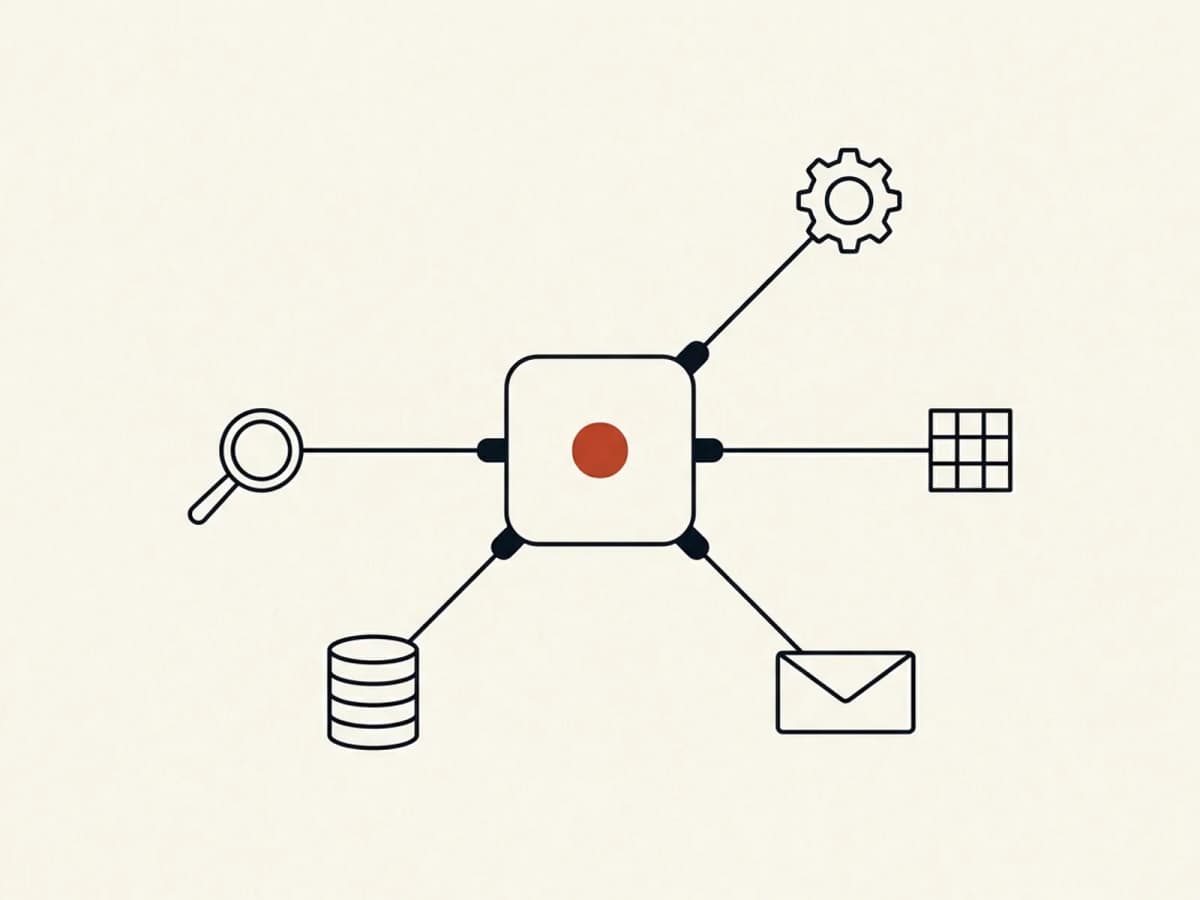 AI
AITL;DR. An AI agent doesn't just answer questions, it acts: it plans steps, calls tools, checks the result and corrects. The Model Context Protocol (MCP) is the open standard that connects LLMs to your tools and data - without building a custom connector for every combination. In 2026, what carries are narrowly scoped agents with clear tools and human control. Fully autonomous "do-everything" agents stay fragile.
from chatbot to agent - the difference
A classic chatbot is a question-answer system: prompt in, text out. An agent gets a goal and the means to reach it. Instead of "here's how you'd create an invoice", an agent does it - it calls the ERP tool, enters the line items, reads back the result and reports: done, here's the document number.
The difference is the action loop: the agent plans a step, executes it through a tool, evaluates the result and decides what comes next - until the goal is reached or a stop condition is hit. This loop turns a language model into something that does work rather than just describing it.
what an agent needs: tools, memory, loops
Three building blocks separate an agent from a chatbot:
Tools. Clearly defined functions the agent can call - read the calendar, create a customer in the CRM, search a file, send an email. Each tool has a description the model uses to recognise when it fits. Good tools are narrow and unambiguous; a "do anything to the database" tool produces chaos.
Memory. Short-term, the conversation history; long-term, a store of relevant facts - often a RAG index over your documents (see RAG explained). Without memory the agent starts from zero at every step.
Control loop. The logic that plans, executes, checks and retries on failure - including clear stop conditions and points where a human has to confirm.
mcp: the usb-c port for ai tools
The problem before MCP: every connection between an AI system and a tool was bespoke. CRM to model A, then again to model B, then to the next tool - quadratic effort.
The Model Context Protocol (introduced by Anthropic in 2024, adopted by OpenAI, Google and Microsoft in 2025) standardises that connection. A tool is exposed once as an MCP server and is then usable by any MCP-capable client. The inventors' analogy: MCP is the USB-C port for AI applications - one plug instead of a tangle of proprietary adapters.
In practice that means: an MCP server you build once for your internal system (inventory, bookings, knowledge base) works with ChatGPT, Claude, Copilot and future clients alike. No lock-in to one vendor, no rebuild every time you switch models.
what carries for smes in 2026
The dependable use-cases are narrowly scoped, not boundlessly autonomous:
- Research agent over your own knowledge base - searches multiple sources, summarises, links evidence. Low risk, high time saving.
- Triage agent for inbound mail - reads messages, classifies, pulls relevant data, drafts a reply (see email personalisation).
- Booking and scheduling agent - checks availability, proposes slots, books after confirmation.
- Data agent - pulls figures from several systems and builds a recurring report.
The pattern: one clear goal, a handful of well-defined tools, a human on the approval for anything with external effect.
where the limits are
Control. The more steps an agent takes autonomously, the harder it is to trace why something went wrong. For anything irreversible - moving money, sending to customers, deleting - a human approval step belongs in the loop.
Cost. Every loop iteration costs tokens. An agent that deliberates ten times where one would have done is expensive. Good agents are frugal with steps.
Hallucination and error propagation. A wrong intermediate step can ripple through the whole chain. Hence: narrow tools, validation of tool results, clear stop conditions.
Our stance: 2026 is not the year of the fully autonomous universal agent. It's the year of the reliable specialist agent - narrow, observable, with a human in the loop.
what we do at tokyn
We build agents for concrete bottlenecks, not for their own sake: first the use-case and a measurable goal, then the minimal tools needed, then the control and approval steps. Where it fits, over MCP - so the setup stays vendor-independent and grows with the next model.
Have a concrete use-case in mind? A 30-minute intro call is free and pitch-deck-free.
sources
related service
more in the journal.
your case, concretely - let's talk.
30 minutes, no pitch deck. We look at your use case and tell you honestly whether - and how - it's worth doing.